

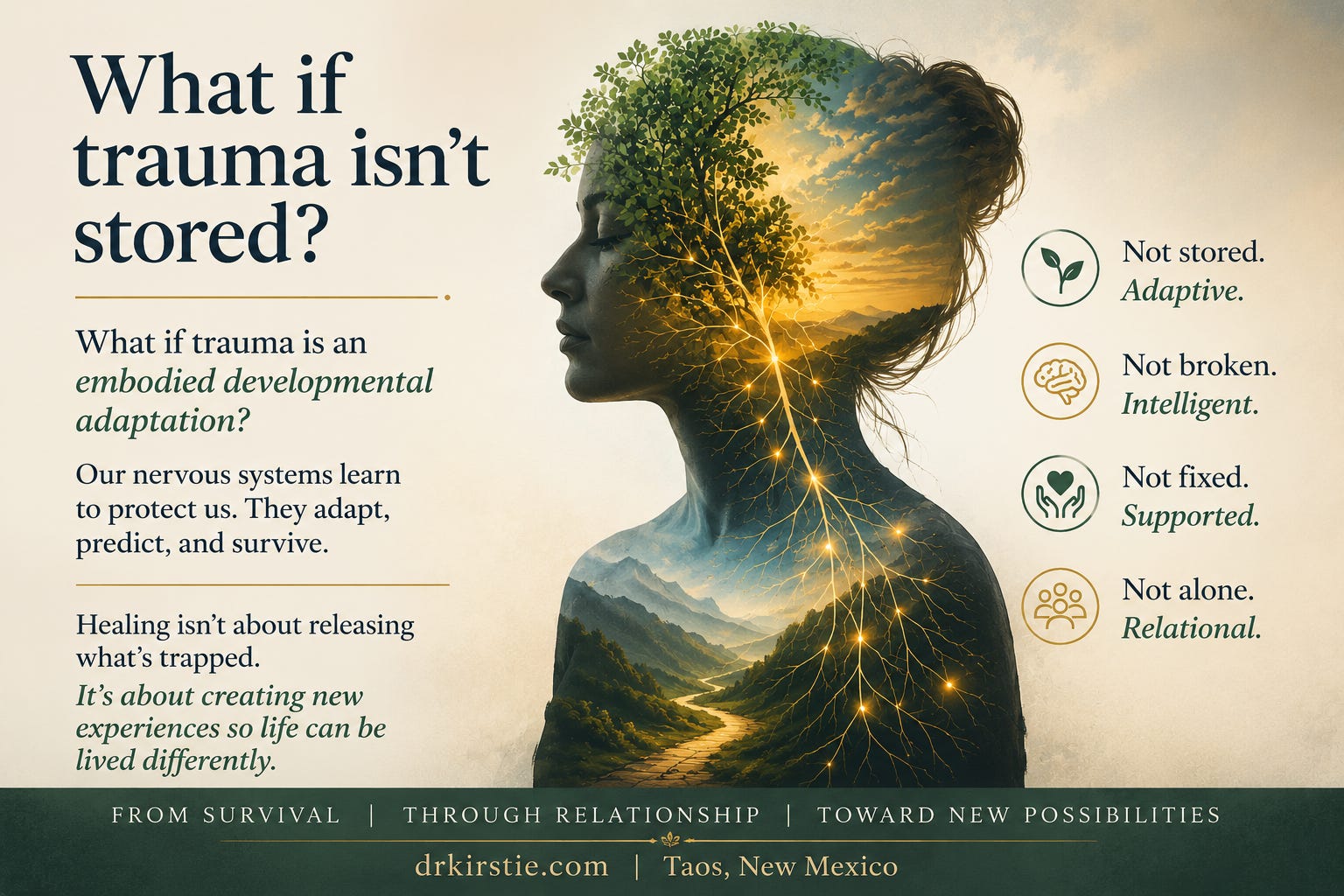
What If Trauma Isn’t Stored?
I’ve been exploring a question for the past several years that has quietly changed how I think about trauma, the nervous system, and healing.
What if we’ve been asking the wrong question?
For decades, we’ve asked where trauma is stored in the body.
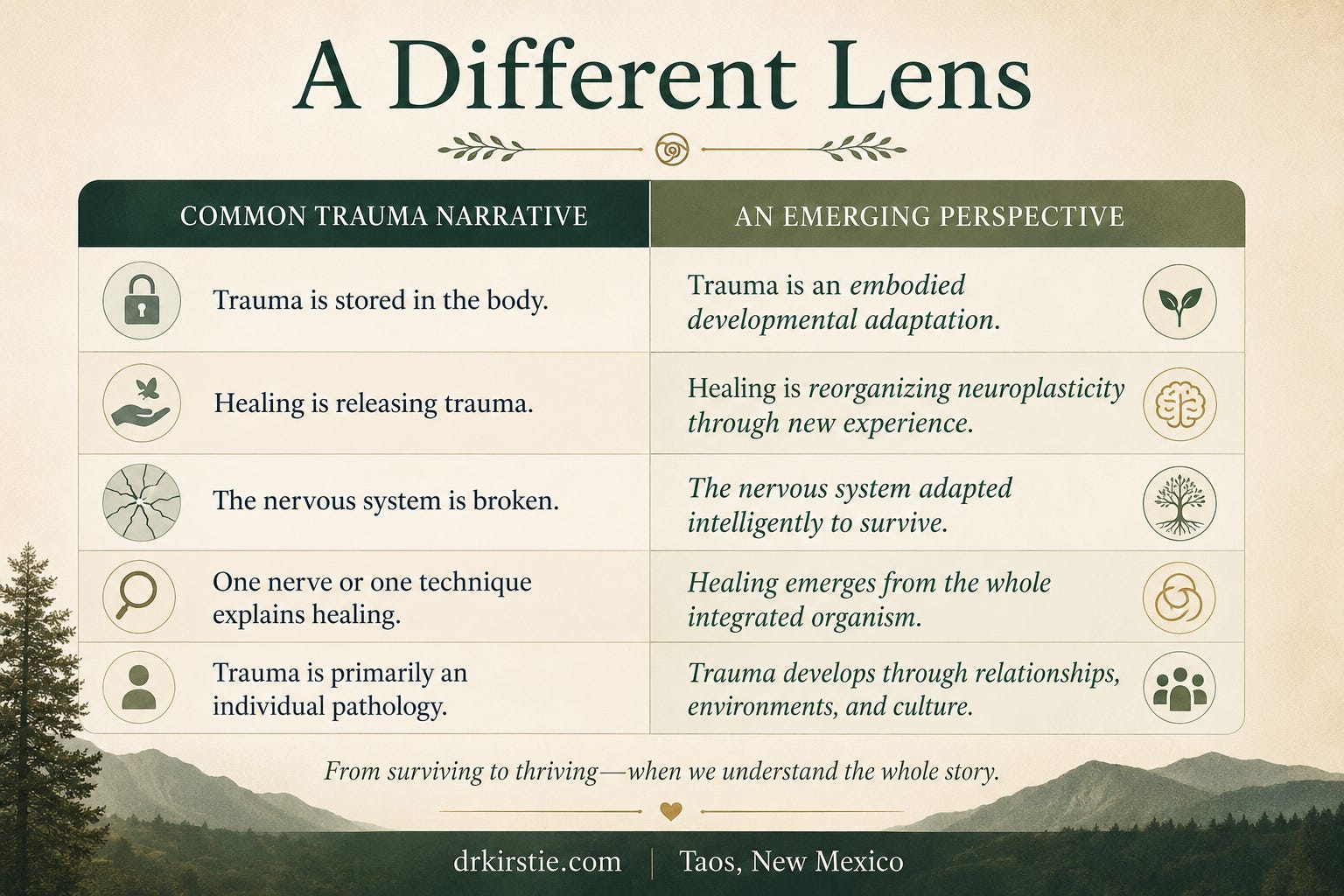
We’ve been told that the body keeps the score. That trauma is trapped or stuck in our tissues. That it needs to be released. That if we find the right technique, the right nerve, or the right therapy, we can finally let it go.
These ideas have shaped an entire generation of trauma-informed practice, and many people have found comfort and healing through them. I know I did. They opened a doorway into understanding that our experiences live far beyond our thoughts.
But science continues to evolve.
And I think our understanding of trauma must evolve with it.
As I’ve immersed myself in osteopathy, embryology, developmental neurobiology, fascia research, and predictive neuroscience, I’ve found myself asking a different question altogether.
What if trauma isn’t something stored inside us?
What if trauma is an intelligent adaptation?
From the moment we begin developing in the womb, our nervous system is growing in relationship with its environment. Our biology is not built in isolation. It develops through connection—to our physiology, our caregivers, our surroundings, and the countless experiences that shape how we learn to survive.
In that sense, trauma isn’t simply an injury.
It is a developmental adaptation.
Our nervous system learns patterns that once made perfect sense. It predicts danger because, at one point, danger was real. It organizes posture, breathing, movement, attention, and relationship around survival.
The remarkable thing is that these adaptations are evidence of our intelligence—not our brokenness.
If this perspective is true, it changes how I think about healing.
Healing isn’t about extracting trauma from the body.
Healing is about creating enough safety, relationship, and new experience that the nervous system no longer needs to make the same predictions.
It is less about release and more about reorganization.
Less about fixing.
More about becoming.
This shift has also made me question many of the reductionistic explanations that have become commonplace in trauma work. We often hear that healing lies in resetting the vagus nerve, releasing trapped trauma, or activating one specific pathway of the nervous system.
Yet embryology tells a different story.
We never developed as isolated nerves or isolated organs.
We developed as relationships.
Brain, fascia, connective tissue, circulation, breath, movement, and perception emerged together as one living system.
Perhaps healing should be understood in the same way.
Not as repairing one part, but as supporting the whole organism in reorganizing itself toward health.
That is the direction my own work has taken.
I’m not interested in dismissing the tremendous contributions of those who have brought trauma into public awareness. Their work has helped countless people, myself included. Rather, I’m interested in asking how our understanding can continue to mature as neuroscience and developmental biology deepen our understanding of what it means to be human.
Perhaps the next chapter of trauma-informed care isn’t about finding better techniques to release what is hidden.
Perhaps it is about recognizing that our bodies have always been doing exactly what they were designed to do—adapting.
And perhaps healing begins when we honor that intelligence.
These are some of the questions I explore in my forthcoming book. My hope isn’t to dismantle trauma-informed practice, but to expand the conversation. The human body has always been more complex, more relational, and more intelligent than our theories can fully describe. As our science evolves, perhaps our understanding of healing can evolve as well.